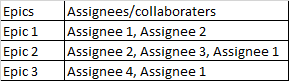
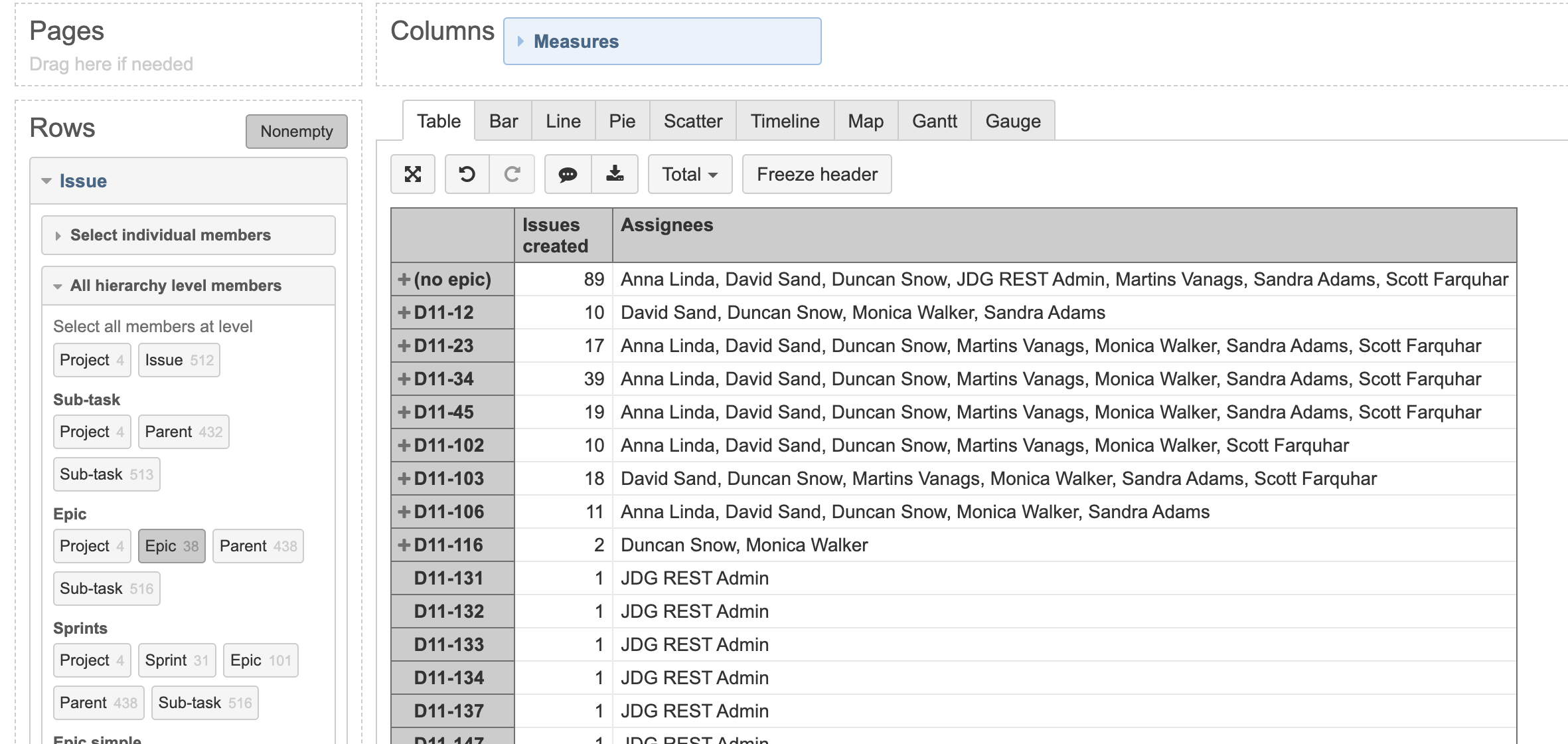
Need to build a calculated member that will hold the values of all the assignee of issues tagged under a Epic. I know we can build this to show a table of epics and when you expand it, it will show the subsequent parent and subtasks with the assignee. But we need something very simple as shown below.
Epics Assignees/collaboraters
Epic 1 Assignee 1, Assignee 2
Epic 2 Assignee 2, Assignee 3, Assignee 1
Epic 3 Assignee 4, Assignee 1
The assignee displayed across each Epic will be the assignee of the epic + assignee of subsequent parent and sub task issues. Is this possible? If yes, how can we achieve this?
In this case, you could create a new calculated measure (with integer format) in “Measures” dimension that would generate all assignees of issues that belog to epic.
Try this code:
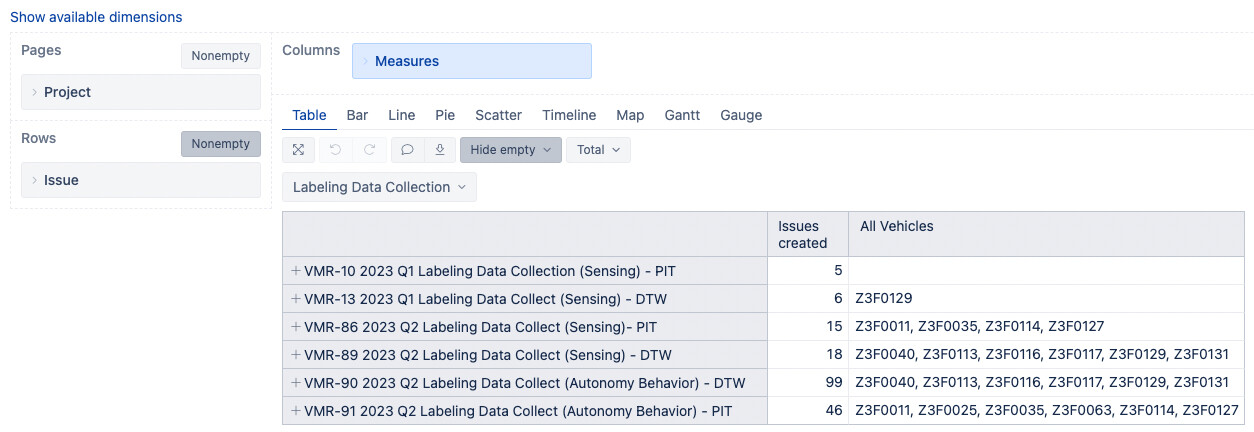
@martins.vanags - is there a modification that can be made to allow for the Time dimension to be used with this code. As an example, I am trying to show what vehicles are assigned to all of the child issues for each epic. Ideally it would list the epic and then the vehicles for the children issues in one cell. I want to split it up per week though based on the creation date of the child issues.
How exactly do you assign the vehicle to a child of an epic (what field do you use in Jira to assign vehicle) and what issue types do you use in jira for epic children?
@martins.vanags thank you for the quick response! All of the epic children are tasks. The vehicle is an asset stored in Insight and it links through a field called Vehicle.
I am currently calculating all of the vehicles listed in the children issues of the epic. My calculate field is “All Vehicles”. I am wanting to add the Time Dimension as a measure so I can break up which vehicles were used based on the week of the creation dates of the child issues (tasks).
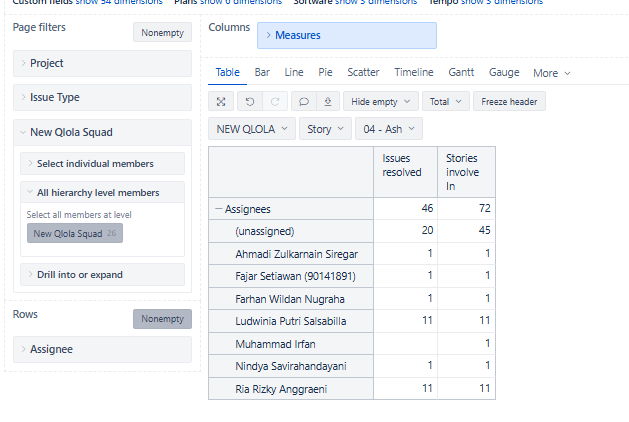
Kindly need your advice, I want to create a report based on subtask assignees that shows where each person is involved, according to the subtasks assigned to them within a story.
I’ve already tried using the formula below, but it only displays the story assignee.
NonZero(Count(
Filter(
– Iterate over all Parent level issues that have children
[Issue.Sub-task].[Parent].Members,
-- Check if any sub-issue exists for the current Assignee context in the rows
([Measures].[Issues created],
 [Assignee].CurrentMember,
 [Issue.Sub-task].CurrentHierarchyMember) > 0
NonZero(
  sum(
  --filter parent level tickets from issue.subtask hierarchy
    Filter(
      DescendantsSet(
        [Issue.Sub-task].CurrentMember,
        [Issue.Sub-task].[Parent]
      ),
      --check if parents belong to page filters
      [Measures].[Issues created]>0
    ),
    --return the sum of parent's children regardless of page filters
    Sum(
      Childrenset([Issue.Sub-task].CurrentMember),
    -- Check if any sub-issue exists for the current Assignee context in the rows
      DefaultContext((
        [Measures].[Issues created],
        [Assignee].CurrentHierarchyMember,
        [Issue.Sub-task].CurrentMember
      ))
    )
  )
)
And please manually select “integer” output format for the measure.
NonZero(
  Count(
    --filter parent level tickets from issue.subtask hierarchy
      Filter(
        DescendantsSet(
          [Issue.Sub-task].CurrentMember,
          [Issue.Sub-task].[Parent]
        ),
        --check if parents belong to page filters
      --return the sum of parent's children regardless of page filters
      (
        [Measures].[Issues created],
        [Assignee].CurrentHierarchy.DefaultMember
      )>0
      AND
      Sum(
        Childrenset([Issue.Sub-task].CurrentMember),
      -- Check if any sub-issue exists for the current Assignee context in the rows
        DefaultContext((
          [Measures].[Issues created],
          [Assignee].CurrentHierarchyMember,
          [Issue.Sub-task].CurrentMember
        ))
      )>0
    )
  )
)
Thank you for helping with the formula. However, when I implemented it, the formula often consumed too much memory because it’s too complex, and no data was displayed.
Do you have any recommendations for filtering so that the data can be displayed?