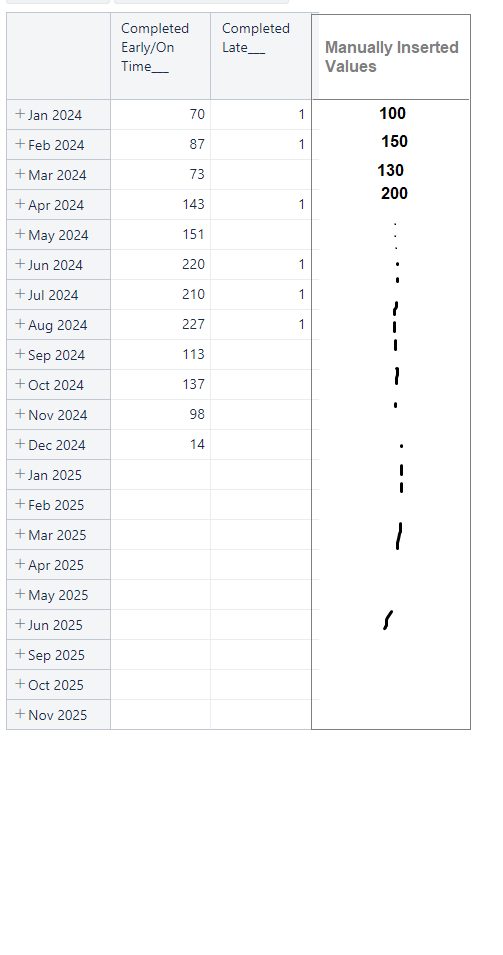
There are a couple of ways how to do this, the simplest one would be to create a new measure in the Measures dimension and use a formula like this:
CASE [Time].CurrentHierarchyMember.Name
  WHEN "Jan 2024" THEN 100
  WHEN "Feb 2024" THEN 150
  WHEN "Mar 2024" THEN 130
  WHEN "Apr 2024" THEN 200
  WHEN "May 2024" THEN 140
  WHEN "Jun 2024" THEN 170
  WHEN "Jul 2024" THEN 110
  WHEN "Aug 2024" THEN 100
  WHEN "Sep 2024" THEN 150
  WHEN "Oct 2024" THEN 200
  WHEN "Nov 2024" THEN 130
  WHEN "Dec 2024" THEN 130
  WHEN "Jan 2025" THEN 120
  WHEN "Feb 2025" THEN 110
END
Let me know if this fits your use case or if you have any additional questions on this!
Best regards,
Nauris
I have a very similar use case but with a lot more data and would like to know if there is a more efficient way to update/import this data.
We have 4-month planning periods and have a Jira custom field for identifying the period the story is completed in. We also have about 10 teams/Jira spaces. For each planning period and team intersection, there is a fixed value of estimated total story points I would like to add to reports.
Is the answer to this original post still the best way to define the values in eazyBI?
Then, you can set up the external data source and perform data mapping. Please ensure to have explicit date for value reference.
Since the imported values will only be mapped to a few dimensions, you need to reset the rest of the report context when retrieving values.
The best way might be as follows.
-- only retain the context of explicitly stated dimensions
DefaultContext(
([Measures].[<imported measure>],
 [Team].CurrentHierarchyMember,
 [Time].CurrentHierarchyMember))
This should allow you to get the saved values in reports based on Jira data.